


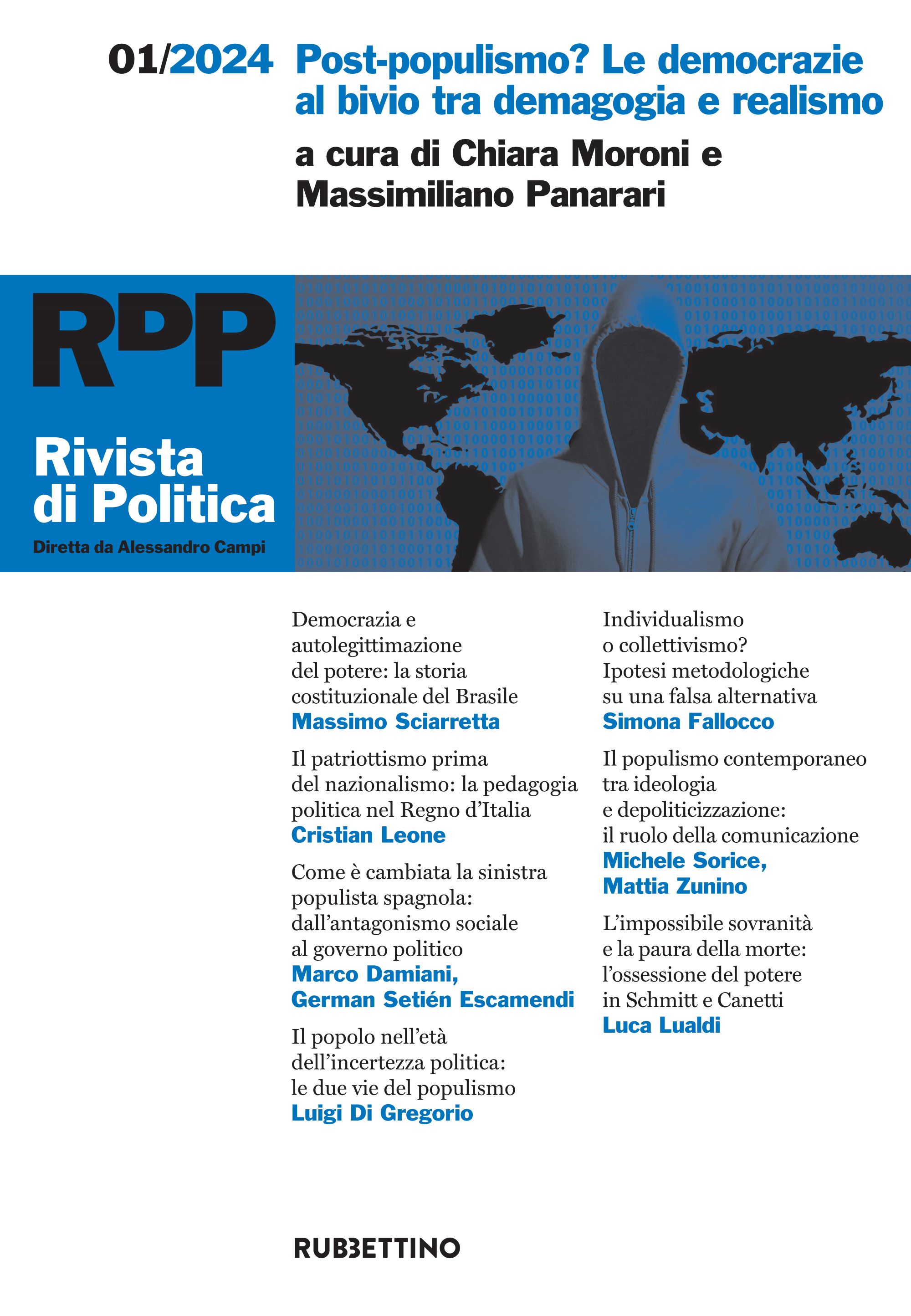
01/2024 – Post-populismo. Le democrazie al bivio tra demagogia e realismo
ISSN: 2037-495X
8,50€ – 11,00€
Descrizione
dossier: post-populismo? come cambiano le democrazie
Post-populismo o nuovo populismo? Riflessioni su un fenomeno in trasformazione Chiara Moroni – Massimiliano Panarari
Populismi fra depoliticizzazione e ideologia Michele Sorice – Mattia Zunino
Fight, Flight o Fright? Le reazioni del demos all’età dell’incertezza: due ipotesi di post-populismo Luigi Di Gregorio
La mentalità populista al governo. Il caso di Giorgia Meloni Chiara Moroni
L’evoluzione identitaria della sinistra populista in Spagna. Il caso di Podemos Marco Damiani – Germán Setién Escamendi
osservatorio internazionale
L’oblio occidentale della «guerra ibrida»: cosa ci siamo persi? Riccardo Allegri
I problemi della democrazia brasiliana nello specchio delle sue Costituzioni Massimo Sciarretta
storia delle idee politiche
La tragedia del potere: Schmitt e Canetti Luca Lualdi
L’individualismo metodologico fra psicologismo e collettivismo Simona Fallocco
storia politica
L’alfabetizzazione politica liberale nel neocostituito Regno d’Italia Christian Leone
Notizie sugli Autori
Abstracts
Abstracts
Michele Sorice, Mattia Zunino, Populism between Depoliticization and Ideology
The article presents an analysis of the relationship among populism, processes of depoliticisation and ideology. In particular, the essay first addresses the complex relationship between depoliticisation and processes of governance, illustrating their impact on the changing public sphere. It then examines populisms – traditionally defined as ideology or political rhetoric – using the notion of social imaginary, which is also useful for a more complete understanding of the role of communicative ecosystems.
Communicative processes, on the other hand, play a role both in the development of the phenomena of political polarisation and those of extremisation that increasingly accompany the emergence of new populisms.
The article tries to show that contemporary populisms constitute a set of ideological narratives that usually accompany and feed the dominant social imaginary, today represented by the neoliberal one.
Keywords: Neoliberalism, Populism, Ideology, Political polarization
Luigi Di Gregorio, Fight, Flight or Fright? The Reactions of the Demos to the Age of Uncertainty: Two Hypotheses of Post-populism
On December 2, 2022, the Censis report “Post-Populist Italy” posited that compounded crises have catalyzed a shift in Italian society to pressing, realistic public demands. Amidst the prolonged pandemic, geopolitical strife, historic inflation, and energy reliance, a new “post-populism cycle” has emerged, wherein populist rhetoric is supplanted by an exigency for practical responses from a political class that is gradually embracing realism and expertise, signaling a potential transformation in governance approach. In response to the ongoing “permacrisis,” the Italian populace shows no signs of mass mobilization or protest, instead further withdrawing from political and public life, as evidenced by decreasing electoral participation. This behavior aligns with Cannon’s classical psychological response models: Freeze, Fight, or Flight when facing threats. Italian society appears to be frozen, unable to take decisive action or confront the challenges directly.
Keywords: Political parties, Populism, Left, Podemos, Identity
Chiara Moroni, The Populist Mentality in Government. The Case of Giorgia Meloni
The mutability of the populist mentality, linked to social and cultural change, to the socio-political context and to the role of the hybrid media system, tends to legitimize different forms of populist expression and changes in political positions due both to political contingency and to the change of role of the populist subject in the institutional system.
This contribution analyzes in particular the difficulty for the Meloni Government in reconciling its oppositional political identity with the need to be concretely proactive and formally institutional. In this sense, it seems correct to us to define the current condition of populists in government in Italy not as the emergence of a post-populist specificity, but on the contrary as one of the possible mutations that the populist mentality can undergo as context conditions change.
Keywords: Populism, Right, Post-populism, Italy
Marco Damiani, Germán Setién Escamendi, The identity evolution of the populist left in Spain. The case of Podemos
This article aims to examine the transformation of Podemos’ identity from its creation in 2014 until the replacement of Pablo Iglesias as its leader in 2021. By using the process tracing methodology, the study sheds light on how institutionalization, along with changes in the country’s economic context, moved Podemos from a phase of “antagonism” to one of political “competition”. Consequently, its entry into the government placed it within the framework of “consensual pluralism” dynamics.
Keywords: Political parties; Populism; Left; Podemos; Identity
Riccardo Allegri, The Western Oblivion of «Hybrid Warfare»: What Have We Missed?
In this article, the author will try to demonstrate how «hybrid warfare» is not a typically modern phenomenon. The combined application of military and non-military tools in the conduct of conflicts can in fact be traced back to antiquity and does not belong to Russian strategic culture alone. The renewed attention to «hybrid» instruments is rather determined by the asymmetry existing between the revisionist powers that resort to them and the US hegemon.
Keywords: Hybrid warfare, Thucydides, New wars, Military strategy, Asymmetry
Massimo Sciarretta, The Problems of Brazilian Democracy in the Mirror of its Constitutions
The many constitutional changes that have punctuated the institutional history of Brazil explain the tendency – on the part of the ruling classes that have taken turns in power – to use the Constitution as a source of their own legitimacy.
Keywords: Constitution, Brazil, Democracy, Power
Luca Lualdi, The Tragedy of Power: Schmitt and Canetti
Both Schmitt and Canetti seem to be deeply obsessed with power. Schmitt has never ceased to assert an individual sovereignty, while Canetti has spent his entire life trying to get rid of that same power. The anonymity into which man is led by the power of the masses, as Canetti theorized, and Schmitt’s inability to affirm a pure individual sovereignty are the factors that ultimately lead to the collapse of both authors’ theoretical approaches.
Keywords: Schmitt, Canetti, power, mass, sovereignty
Simona Fallocco, Methodological Individualism between Psychologism and Collectivism
Collectivists assimilate the methodological individualism of the evolutionary tradition to the homo oeconomicus tradition that incurs the methodological mistake of psychologism. The homo oeconomicus approach is a construction concerned with the concept of maximization that the methodological individualism neglects because it is disconnected from all social dimensions. This paper aims to demarcate the boundaries between the two traditions and argue that the search for a methodological “third way” between collectivism and psychologism is superfluous because the methodological individualism is already a “third” approach: the one that rejects both the hypersocialized actor shaped by institutions and the selfish actor who ignores the intersubjective relationship.
Keywords: Individualism, Collectivism, Homo oeconomicus, Third way
Christian Leone, Liberal Political Literacy in the newly established Kingdom of Italy
The liberal ruling class, with the constitution of the Kingdom of Italy and in the context of an emerging mass society, must face the unresolved problem of integrating citizens into the new national state. The constitutional forces, with a unitary process conducted substantially from above and without a party structure, entrust the task of creating a common feeling of identity around the newborn institutions to a vast and heterogeneous network of irredentist and patriotic organisations, bodies and circles. The purpose of this essay is to investigate, beyond the individual formations and the varied fields of action, the origin, the function and the multiple activities of this liberal association, advocate of a patriotic but not nationalist pedagogy.
Keywords: Monarchy, Mobilization, Patriotism, Liberalism